If you’ve ever kept a gratitude journal, you know they’re fairly easy to fill. Edward King, an English bishop known for working with the poor, may not have had a fancy journal. But these words evoke such a list: “I will thank God … for the glory of the thunder, for the mystery of music, the singing of birds and the laughter of children. … for the awe of the sunset, the beauty of flowers, the smile of friendship and the look of love … for the leaves on the trees in spring and autumn, for the witness of the leafless trees through the winter, teaching us that death is sleep and not destruction, for the sweetness of flowers and the scent of hay. Truly, oh Lord, the earth is full of thy riches!”
King concludes: “And yet how much more I will thank and praise God for the strength of my body enabling me to work, for the refreshment of sleep, for my daily bread, for the days of painless health, for the gift of my mind and the gift of my conscience, for his loving guidance of my mind ever since it first began to think, and of my heart ever since it first began to love.”
May we also overflow with gratitude galore this week and always to our Father of heavenly lights, the Giver of every good and perfect gift.
Missionary and author Elisabeth Elliot says our sovereign God is worthy of unquestioning obedience in matters both large and small. Such trust yields mighty results, she adds, providing Christians with rest, peace and guidance.
“God is God,” says Elliot. “Because he is God, he is worthy of my trust and obedience. I will find rest nowhere but in his holy will that is unspeakably beyond my largest notions of what he is up to.”
About the role of obedience in prayer, Elliot asks, “Does it make sense to pray for guidance about the future if we are not obeying in the thing that lies before us today? How many momentous events in Scripture depended on one person’s seemingly small act of obedience! Rest assured: Do what God tells you to do now, and, depend upon it, you will be shown what to do next.”
While on a red-eye flight from California to Philadelphia on a stormy night, evangelist Tony Campolo sat near someone who wanted to chat. Upon learning that Campolo was a Christian, the seatmate said, “I believe that going to heaven is like going to Philadelphia,” meaning you can get there by various modes of transportation. “We all end up at the same place.”
When Campolo woke from a nap and saw that the descending airplane was circling Philly in the fog, he told his neighbor, “I’m glad the pilot doesn’t agree with your theology.” Confused, the man asked what Campolo meant.
“The people in the control tower are giving instructions to the pilot: ‘Coming north by northwest, three degrees, you’re on beam, don’t deviate from the beam.’ I’m glad the pilot’s not saying, ‘There are many ways into the airport. There are many approaches we can take.’ I’m glad the pilot’s saying, ‘There’s only one way we can land this plane, and I’m going to stay with it.’”
Pastor and hymn writer Phillips Brooks penned these words in the 19th century, but they’re just as relevant for Jesus’ followers today:
“[People] are questioning now, as they never have questioned before, whether Christianity is indeed the true religion … . Can [Christianity] meet all these human problems, and relieve all these human miseries and fulfill all these human hopes?
“It is for us, in whom the Christian church is at this moment partially embodied, to declare that Christianity … can do for the world [that] which the world needs.
“You ask, ‘What can I do?’
“You can furnish one Christian life — so faithful to every duty, so ready for every service, so determined not to commit every sin — that the Christian church shall be stronger for your living in it; and the problem of the world be answered; and a certain peace come into this poor, perplexed phase of our humanity as it sees that new revelation of what Christianity is.”
There is a better way, a humble and truthful way, and it is up to us as Christians to guide others.
“How much longer until it’s Christmas?” When my children were little, they asked this question repeatedly. Although we used a daily Advent calendar to count down the days to Christmas, they still found the waiting excruciating.
We can easily recognize a child’s struggle with waiting, but we might underestimate the challenge it can involve for all of God’s people. Consider, for instance, those who received the message of the prophet Micah, who promised that out of Bethlehem would come a “ruler over Israel” (5:2) who would “stand and shepherd his flock in the strength of the Lord” (v. 4). The initial fulfillment of this prophecy came when Jesus was born in Bethlehem (Matt. 2:1) —after the people had waited some 700 years. But some of the prophecy’s fulfillment is yet to come. For we wait in hope for the return of Jesus, when all of God’s people will “live securely” and “his greatness will reach to the ends of the earth” (Mic. 5:4). Then we will rejoice greatly, for our long wait will be over.
Most of us don’t find waiting easy, but we can trust that God will honor His promises to be with us as we wait (Matt. 28:20). For when Jesus was born in little Bethlehem, He ushered in life in all its fullness (see John 10:10)—life without condemnation. We enjoy His presence with us today while we eagerly wait for His return.
After “turkey day” came and went last year, a pastor challenged church members to ask one another not “How was your Thanksgiving?” but “How is your Thanksgiving?” After all, giving thanks should be an ongoing act.
That doesn’t always need to be profoundly deep, either. A.J. Jacobs, author of Thanks a Thousand, once asked a philosophy-professor friend what he was grateful for. The shockingly simple reply? “Sometimes I’m just grateful I have arms.” That odd but spot-on answer shows the importance, Jacobs says, of being “thankful for things so omnipresent that they can escape our notice.”
He made the moon to mark the seasons. Psalm 104:19
Leisa wanted a way to redeem the season. So many of the autumn decorations she saw seemed to celebrate death, sometimes in gruesome and macabre ways.
Determined to counter the darkness in some small way, Leisa began to write things she was grateful for with a permanent marker on a large pumpkin. “Sunshine” was the first item. Soon visitors were adding to her list. Some entries were whimsical: “doodling,” for instance. Others were practical: “a warm house”; “a working car.” Still others were poignant, like the name of a departed loved one. A chain of gratitude began to wind its way around the pumpkin.
Psalm 104 offers a litany of praise to God for things we easily overlook. “[God] makes springs pour water into the ravines,” sang the poet (v. 10). “He makes grass grow for the cattle, and plants for people to cultivate” (v. 14). Even the night is seen as good and fitting. “You bring darkness, it becomes night, and all the beasts of the forest prowl” (v. 20). But then, “The sun rises . . . . People go out to their work, to their labor until evening” (vv. 22–23). For all these things, the psalmist concluded, “I will sing praise to my God as long as I live” (v. 33).
The wedding bells were ringing loud and clear this past Saturday as this writer and preacher had the privilege and honor of participating in the wedding of Martin and Sara.
This couple, along with their families, had spent countless hours preparing for their special day with much emphasis placed upon coordinating and calculating every conceivable (and often inconceivable) possibility. However, the most essential item in all of this planning is another word, that is the most important item in ALL relationships: communication!
As a matter of a fact, a certain wedding counseling “professional” usually begins his first session with the following statement: What are the 3 most important items in a long and successful marriage?
The answer is… 1) Communication 2) Communication 3) Communication!
Interestingly enough, this ‘C’ word is also vital in our relationship as a follower of our Lord. Our Savior longs forus to communicate with Him. In the gospels, with an assist from the Thompsons’ Chain-Reference Bible, we find that Jesus’ disciples were constantly telling Him about different things happening in their lives. Check out a few of those that were listed:
Their Perils – MT 8:25; Their Questions – MT 24:3; Their Sicknesses – MK 1:30;
Their Difficulties – MK 6:35-44; Their Victories – LK 10:17; Their Bereavements – JN 11:21-23
Our job is not only to communicate the Good News to all we meet (MT 28:19, 20), but it is also to communicate WITHthe Good News! The Good Shepherd had this to say regarding His relationship with His Flock: “I am the good shepherd; I know my sheep and…MY SHEEP KNOW ME”(John 10:14, emphasis added)
How can we know Jesus if we fail to communicate with Him? It must begin with a purpose of relationship from deep within our desires! The Good News is… HE is the Good News. And Hewants and waits for you and me to respond.
“Here I am! I stand at the door and knock. If anyone hears my voice and opens the door, I will come in and eat with him, and he with me.” (Revelations 3:20)
Let us all desire this type of relationship with Jesus as we communicate and try to understand one final ‘C’ word… Commitment! To do so, let us bring our discussion to a conclusion with a few words from the Apostle Paul regarding an additional wedding analogy.
“Husbands, love your wives, just as Christ loved the Church and gave himself up for her.” (EPH 5:25)
Christ WAS and IScommitted to us. Let us communicate with Him!
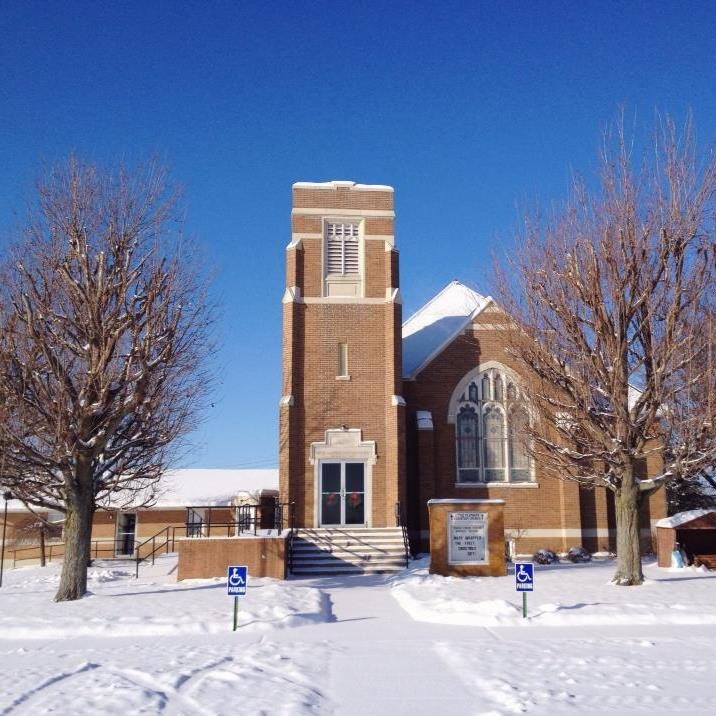










 Little Flatrock Christian Church