
Sharing a Cup of Comfort

And our hope for you is firm, because we know that just as you share in our sufferings, so also you share in our comfort.  —  2 Corinthians 1:7

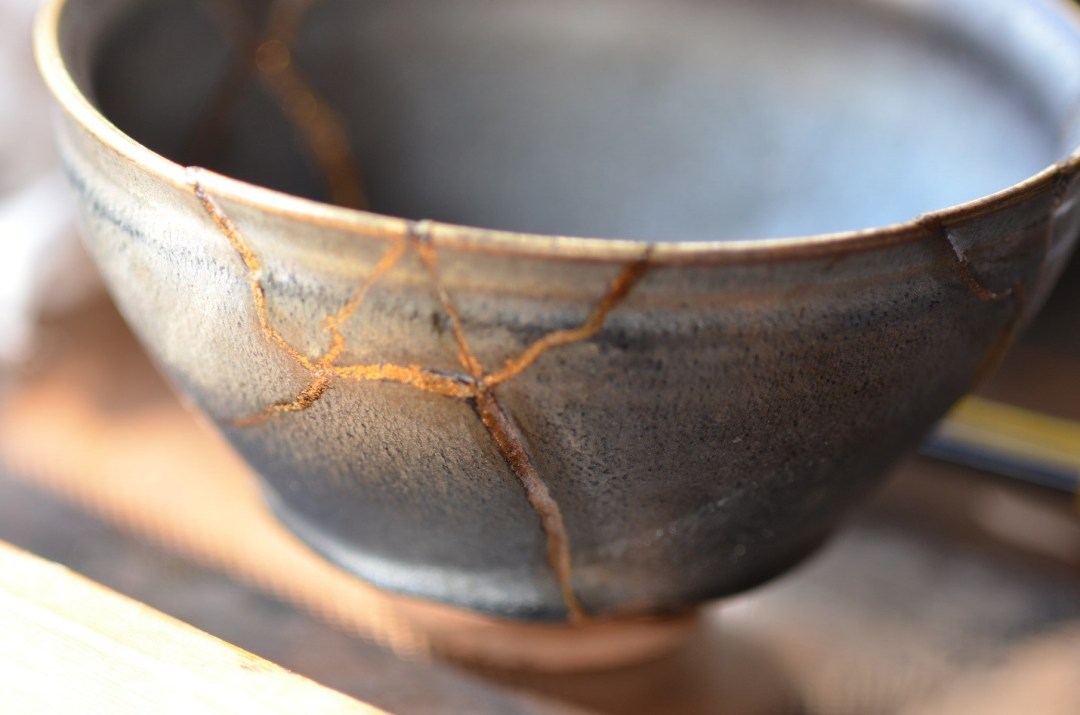
A friend mailed me some of her homemade pottery. Upon opening the box, I discovered the precious items had been damaged during their journey. One of the cups had shattered into a few large pieces, a jumble of shards, and clumps of clay dust. After my husband glued the broken mess back together, I displayed the beautifully blemished cup on a shelf.

Like that pieced-together pottery, I have scars that prove I can still stand strong after the difficult times God’s brought me through. That cup of comfort reminds me that sharing how the Lord has worked in and through my life can help others during their times of suffering.

The apostle Paul praises God because He is the “Father of compassion and the God of all comfort” (2 Cor. 1:3). The Lord uses our trials and sufferings to make us more like Him. His comfort in our troubles equips us to encourage others as we share what He did for us during our time of need (v. 4).

As we reflect on Christ’s suffering, we can be inspired to persevere in the midst of our own pain, trusting that God uses our experiences to strengthen us and others toward patient endurance (vv. 5–7). Like Paul, we can be comforted in knowing that the Lord redeems our trials for His glory. We can share His cups of comfort and bring reassuring hope to the hurting.

mended pottery

By: Xochitl Dixon in Our Daily Bread

stack of love wooden blocks

We’re so accustomed to hearing the Bible’s “love chapter,” 1 Corinthians 13, at weddings and other occasions that we may not really hear its meaning anymore. It can help to listen to something familiar said in different words. What new understandings of love does this paraphrase from The Message Bible reveal to you?

“Love never gives up. Love cares more for others than for self. Love doesn’t want what it doesn’t have. Love doesn’t strut, doesn’t have a swelled head, doesn’t force itself on others, isn’t always ‘me first,’ doesn’t fly off the handle, doesn’t keep score of the sins of others, doesn’t revel when others grovel, takes pleasure in the flowering of truth, puts up with anything, trusts God always, always looks for the best, never looks back, but keeps going to the end. Love never dies” (1 Corinthians 13:4-8a, MSG).

Throwing (Tiny) Stones

grayscale photography of four women wearing clothes

“I drop kindness pebbles in still water every day, and I watch the effect they have on other people’s lives. My favorite kindness pebbles are compliments. Drop a compliment and watch the ripple effect that it has in your life.”

Remarkably, these cheery words come from a father who has faced many dark, difficult days. In 6 Minutes Wrestling With Life, John Passaro tells of his daughter’s heart-wrenching battle with meningitis. The struggles didn’t make him bitter; rather, he frequently offers uplifting words on social media.

What if we followed Passaro’s example and complimented people regularly? Philippians 4:8 (NIV) instructs us to think about things that are noble, lovely, admirable, excellent and praiseworthy. By extension, turning those positive thoughts into words causes “kindness pebbles” to spread God’s light in ripples throughout someone’s day — and, doubtless, through ours.

God’s Gentle Leading

I drew them with gentle cords, with bands of love. —Hosea 11:4

two white and black cows inside shed

It was a fascinating study in contrasts at the county fair. A rugged rancher led his cattle into the corral with shouts, curses, and beatings. The animals were wild-eyed and hard to manage.

Then a girl about 14 led her prize-winning cow in. She spoke softly and reassuringly to the animal, stroking her and pulling gently on the rope. The beautiful holstein walked calmly into the pen.

Hosea the prophet used farm imagery to describe how the Lord leads His people. Referring to Israel’s journey from captivity in Egypt, he said that God “drew them with gentle cords, with bands of love” (Hos. 11:4). God had heard their anguished cries from Egypt. He led them lovingly, as a farm girl leads her cherished colt or prized heifer, to the place of His blessing. But that privileged relationship was about to change. Because of Israel’s obstinate refusal to follow the Lord, He was about to turn them over to those who would oppress them and treat them roughly.

Thank God that He chooses to lead us with “bands of love.” The road we are traveling is often difficult, but His leading is gentle. As we allow the quiet voice of the Spirit to apply God’s Word to our hearts, we will be content.

God holds the future in His hands
With grace sufficient day by day;
Through good or ill He gently leads,
If we but let Him have His way. —Rohrs

— from Our Daily Bread, 1995


We welcome you to join us at LFCC each Sunday morning at 10:15 a.m. for the new sermon series over the Minor Prophets (Hosea, Joel, Amos, Obadiah, Jonah, Micah, Nahum, Habakkuk, Zephaniah, Haggai, Zechariah, and Malachi).

Three Questions for the New Year

pexels-photo-3401900.jpeg

There’s a tale of a traveling priest who was confronted by a soldier in pre-revolutionary Russia. Rifle in hand, the soldier barked, “Who are you? Where are you going? Why are you going there?”

Instead of answering, the priest asked how much the soldier was paid — and offered double if the soldier would challenge him with those three questions each day as he passed by.

Those three important questions can guide us on our journey through the brand-new year ahead. For Christians, thankfully, the answers are clear:

• Who are you? “I’m a child of God!”
• Where are you going? “I’m going out into the world!”
• Why are you going there? “I’m going out of love for Jesus, who died for me!”

Place these questions and answers in a spot where you can see them each day. Then go forward confidently, knowing “whose” you are and what your purpose is.

This Is the Time

woman on rock platform viewing city

This is the time of endings, but of new beginnings, too…
God sends us another year and maketh all things new…
Another hope, another chance, another road to take…
Another star to follow, and another start to make…
New beginnings, new adventures, new heights to attain…
Golden opportunities to work and build again…
New and higher aspirations, for the future days…
Seeking, dreaming, moving on to bright and better ways.

— Patience Strong

Light Shines in the Darkness

In Nepal, where blindness is prevalent due to under-funded medical care and a lack of eye doctors, ophthalmologist Sanduk Ruit has made it his mission to treat poor people. He’s performed more than 130,000 cataract surgeries to restore sight, sometimes walking for a week with surgical equipment in tow to reach patients. Dr. Ruit also found a way for replacement lenses to be made locally for less than $3 each, rather than buying them internationally for 100 times as much. The physician brings healing to remote villages and celebrates “big eye-opening festivals” with people who “were blind yesterday, and … are seeing today.”

At Christmas we celebrate the Word of God who came to live among us as Jesus, the light of the world. In countless ways since, God has brought light to those living in literal or figurative darkness.

We celebrate people, such as Dr. Ruit and the 650 doctors he has trained, whom God uses to cause “light [to shine] in the darkness” (John 1:5).

light of world

“In the same way, let your light shine before others, that they may see your good deeds and glorify your Father in heaven.”  Matthew 5:16

Exercising Our Gratitude Muscles

give thanks

Expressing gratitude isn’t just a good thing to do; it also appears to be good for us! Indiana University researchers found that participants who performed gratitude-focused writing exercises felt uplifted, and were more likely to express gratefulness through generosity, even weeks later.

Furthermore, brain scans revealed increased gratitude-related activity even months down the road (New York Magazine).

Though the study was small, we seem to have a “gratitude muscle” that can be strengthened through exercise. If so, there may be more than we thought to the popularity of gratitude journals and Mom’s insistence that we write thank-you notes. Not to mention the biblical call to “give thanks to the LORD, for he is good” (1 Chronicles 16:34, for example).

Might God have hardwired us for gratitude — not only at Thanksgiving but year round — because it’s good for us as well as for those we thank? To that, we respond, “Thanks be to God!”

A Life of Thanks Giving

woman s hand using a pen noting on notepad

Numbered lists grab our attention. In the checkout aisle or on the internet, we gravitate toward headings such as “10 ways to lose weight by summer!” or “3 simple steps to acing that test!”

Ancient Jewish sages urged people to count out and speak at least 100 blessings, or statements of gratitude, each day. What would happen if we intentionally listed 100 blessings daily? Can you imagine?!

What if the first blessing we counted was simply the day itself? “Thank you, God, for this brand new day!” “Bless my use of this day, Lord, that I might glorify you.” Scripture encourages such awareness and promises an additional blessing in return: “Teach us to number our days, that we may gain a heart of wisdom” (Psalm 90:12, NIV).

—Heidi Mann

Jumping to Conclusions

brown leather wallet and us dollar banknote

John was driving home late one night when he picked up a hitchhiker.  As they rode along, he began to be suspicious of his passenger.  John checked to see if his wallet was safe in the pocket of his coat that was on the seat between them, but it wasn’t there!  So he slammed on the brakes, ordered the hitchhiker out, and said, “Hand over the wallet immediately!”  The frightened hitchhiker handed over a billfold, and John drove off.  When he arrived home, he started to tell his wife about the experience, but she interrupted him, saying, “Before I forget, John, do you know that you left your wallet at home this morning?”

Let’s be careful not to form our opinions about others until we have all the facts.  Instead, we should first take an honest look at ourselves.  Many unkind words have been spoken and many relationships have been hurt because someone was too quick to judge another person.  How important it is not to jump to conclusions!

Why do you look at the speck in your brother’s eye, but do not perceive the plank in your own eye?  Luke 6:41


— from Our Daily Bread, the Collector’s Edition